
There are over 80 peaks in the Italian Dolomites that reach over 3000 meters, and Catinaccio d’Antermoia is one of them. It’s also the tallest summit in its group. Thanks to Via Ferrata Catinaccio, reaching the top is easily accessible even to beginners, making it an excellent possibility to bag one of the highest summits in the Dolomites.
Total round-trip distance
16.6 kilometres / 10.3 miles
Elevation gain
1230 meters / 4035 feet
Difficulty
Beginner (B)
Time required
8-10 hours


Overview of the via ferrata
Via ferrata Catinaccio d’Antermoia leads to the highest peak in the Rosengarten group in the Western part of the Italian Dolomites. Despite the high altitude, this is a beginner-level via ferrata. You can tackle it on a day excursion or stay overnight in one of the mountain huts en route. The approach to reach the via ferrata is quite long, but don’t let that put you off. Standing on the summit with 360 degree view of the Dolomites is well worth the effort.
From the summit of Catinaccio, you can look down to Lake Antermoia, Marmolada – Dolomite’s highest peak, and Sassolungo – the prominent peak and one of the most iconic photo subjects in the area. On a clear day, you can even see the Austrian Alps in the distance.
TIP: I have done the Catinaccio via ferrata as part of a 5-day hut-to-hut traverse across the Rosengarten group. If you have a few days, I highly recommend this traverse.
The map & elevation profile of via ferrata Catinaccio d’Antermoia
Important info about the via ferrata Catinaccio d’Antermoia
When to go: Mid-June to October
Via ferrata exposition: east, west
Trail numbers: 546, 584
Highest point: 3002 meters / 9849 feet
Map required: Tabacco 029 (Schlern – Rosengarten) or Tabacco 06 (Val di Fassa)
Parking: bottom of the Vajolet chairlift
Start/End: Top of the Vajolet II chairlift
Nearest towns: Pera, Pozza, Vigo & Campitello in the Fassa Valley


Getting there
The quickest way to reach the via ferrata Catinaccio is to take the two-tier Vajolet chairlift. Its base is in Pera di Fassa, and then walk for 2.5 hours along a well-maintained path.
By bus
Search for connections on the Süd Tirol Mobil website. The name of the bus stop near the chairlift station is Pera Di Fassa, Vajolet.
By car
If you are travelling with a car, there are two parking lots at the bottom of the chairlift.
Stages of the via ferrata Catinaccio d’Antermoia
Approach: Top of the Vajolet II chairlift to Rifugio Passo Principe
- One-way distance: 6.5 km / 4 mi
- Elevation gain: 800 m / 2625 ft
- Time required: 2.5 -3 hours
It’s quite the hike to Passo Principe, where the Via Ferrata Catinaccio starts. From the top of the chairlift, first follow the signs for Rifugio Gardeccia (ca. 30 minutes). From Rifugio Gardeccia, take path no. 546 to Rifugio Vajolet (around 1 hour). Make sure to briefly stop here to admire the beautiful Vajolet towers visible to the left. The route then continues upward onto path no. 584 for another hour to Rifugio Passo Principe (Grassleitenpasshütte) – one of my favourite Dolomite mountain huts. The summit of Catinaccio will eventually be directly in front of you.
Via Ferrata: Rifugio Passo Principe – Catinaccio – Rifugio Passo Principe
- Round-trip distance: 3.5 km / 2.2 mi
- Elevation gain: 430 m / 1410 ft
- Time required: 3-4 hours
Stand with your back facing the hut. Directly in front of you is the scree path going up. That’s the path you will have to take. Turn left and follow the ledge and the prominent red paint marks until you reach a ladder that you have to climb down. After that, the route continues up in big zigzags.
There are many exposed sections on Via Ferrata Catinaccio, but they are all well equipped with cables. With every meter of elevation gained, the views into the Rosengarten group get better and better. The last 50 meters leading to the summit are very exposed, and the cables disappear. I would lie if I said I wasn’t feeling a bit uneasy. Make sure you go slowly and place your feet steadily.
Descent: Rifugio Passo Principe to the top of the Vajolet II chairlift
- One-way distance: 6.5 km / 4 mi
- Elevation loss: 800 m / 2625 ft
- Time required: 2.5-3 hours
The descent is on the other side of the mountain, and, as with the ascent, it’s signalled by red paint marks. The route down still involves many cables. You will reach Antermoia Valley (Val D’Antermoia) in ca. one hour after leaving the summit. From here, you have to continue upward on path no. 584 to Passo Antermoia, then across to Rifugio Passo Principe.


Overnight stay & dining possibilities
There are quite a few huts you will pass en route, which means plenty of possibilities to quench your thirst or hunger. Rifugio Gardeccia is the first one, and you will pass it 30 minutes into the approach route. Next come Rifugio Preuss and Vajolet approximatelt one hour into the trail.
My favourite hut along the route is Rifugio Passo Principe. That’s where the via ferrata Catinaccio starts. I highly recommend staying here overnight. Not only is it the most remarkable building structure I have seen in the Dolomites, but it also has the most amicable atmosphere, a very cheerful owner, and a cute Border Collie named Chiaco to keep you company. The hut also underwent some renovation recently, and I cannot wait to check out what improvements they made.
TIP: If you have never stayed in an alpine hut before, this article will teach you all the details that you should know before you book your stay.

Where to stay nearby
Canazei, Campitello, Vigo Di Fassa, Pozza di Fassa or Moena are just a few towns in the famous Fassa Valley in the Italian Dolomites. They all lie within a few minutes’ drive of one another and are great places to base yourself for exploring the trails in the Dolomites. If you are tackling the Catinaccio via ferrata as a day excursion, you can return to your hotel the same day. Here are a couple of my recommendations for hotels in Val Di Fassa
Best Value
Self-catering apartments are only a 10-minute walk from the centre of Canazei in the Fassa Valley.
Top Rated
Locanda degli Artisti Art Hotel
This lovely hotel has a fantastic bar and restaurant. It is a great place for art lovers, and the hotel boasts some quirky art decorations.


Other activities nearby
Shop my via ferrata gear essentials

Black Diamond Helmet
Rockfall is a significant concern on via ferrata routes. Unbeknownst to you, other climbing groups above you may accidentally dislodge a small rock and send it down the mountain. If it hits you on the head, it could have serious consequences. A helmet on your head (not inside your backpack) is necessary.
Shop on: Amazon (Worldwide) / Backcountry (US)

Black Diamond Momentum Harness
Another must-have on a via ferrata route is a climbing harness. A harness works as an anchor point for your via ferrata lanyard. Try it before your trip to ensure it fits snugly without limiting your movements. Aim for a lightweight harness that will be comfortable to wear between the cable-protected sections when hiking.
- Shop Women’s on Amazon (Worldwide) / Backcountry (US)
- Shop Men’s on Amazon (Worldwide) / Backcountry (US)

Edelrid, Camp or Black Diamond Via Ferrata Lanyard
A via ferrata lanyard connects the climber and their harness to the cables along the route. Its two arms and a hidden extra coil work as an energy absorption system in case of a fall. The two carabiners at the end of the lanyard clip into the cable. Make sure the carabiners are equipped with the palm squeeze mechanism. It’s the safest and most comfortable.
Shop on Amazon (Worldwide) / Backcountry (US)

Black Diamond Crag Gloves
The gloves protect your hands from cuts and scratches you may otherwise get if you haul yourself on the cable without them. I prefer full-finger gloves for extra protection against blisters. If your hands sweat quickly, go for the fingerless version.
Shop on: Amazon (Worldwide) / Backcountry (US)

Salewa Wildfire Edge Approach Shoes
This is my go-to pair of hiking shoes for more accessible trails or via ferrata, where I don’t need extra ankle support. They provide excellent grip on the rock and are very durable.
Shop on: Amazon (Worldwide) / Backcountry (US)
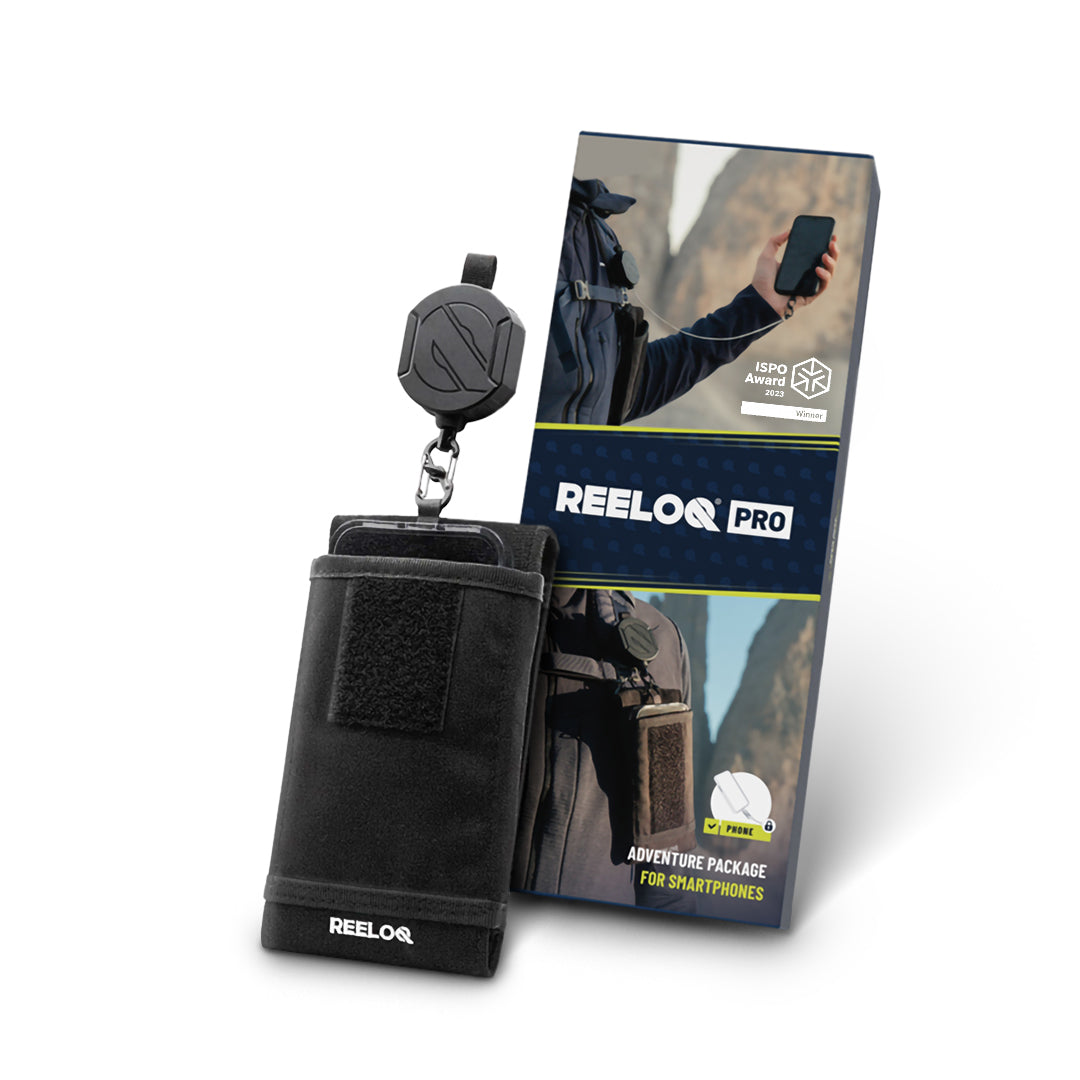
Reeloq Smartphone Securing System
If you want to take great photos on a via ferrata without worrying about losing your phone, Reeloq is the best tool for it. It’s a smartphone-securing system that allows you to use your phone on any adventure. This has been a great addition to my tool arsenal.
Shop on: REELOQ
Support my website!
Hi Reader! If you found any of my articles about the Dolomites useful please consider using the affiliate links below (at no extra cost) when booking your holiday. Thank you
- Reserve your hotel with Booking.com
- Book your rental car with Discover Cars
- Buy your outdoor gear with Backcountry.com (US readers)
If you have any questions, leave them in the comments below!
Hi Marta,
Thank you for having such a helpful website! Is there any chance you have the gpx or kml files available that you used for making the map? In particular, I’m looking for the gpx for your Via Ferrata Catinaccio loop, since I’ve only been able to find the tracks for the Ferrata itself on other sites (not the descent on the trail to get back to the hut). I’m sure it will be easy enough to find my way without it, but always nice to have if possible!
Thanks,
Tom
Hi Tom. Thanks for the feedback. Please email me directly through my contact page.
Hi Marta – On our second day, we are planning to go from Rifugio Santner to Rifugio Antermoia over VF Catinaccio. Could you tell me the best path to get to Refigio Antermoia from the VF Catinaccio? Thank you!
Hi Maggie. Thanks for following. You will be able to see Lago Antermoia from the summit of Catinaccio (providing the weather is good). Rifugio Antermoia is right next to it. Once you descend from the Summit of Catinaccio on the other side instead of turning right onto path no. 584 towards passo di Antermoia you turn left towards rifugio Antermoia. Don’t worry there will be signs. Also make sure to carry a map with you. Happy hiking!
I’ve read that this VF is usually done West to East as you have done. We’ll want to do it in reverse. Any reason not to?
We are experienced mountain hikers, but have only a little VF experience.
Hi Davide. I think most people do it from West to East because the approach is easier to Passo Principe. Whichever way you do it you will have to downclimb some via ferrata sections. There will be more downclimbig on the West side, but since it’s a beginner ferrata it shouldn’t pose a problem. Make sure you are properly equipped and know how to use the gear. I hope that helps.
Hi Marta, we just did the Santner via ferrata as our first one and it was great!! But it took us way longer than you described, like 3hrs from rif Fronza to rif santner. How do you think the difficulty of santner compared to this one? We also found the descent from santner to rif vajolet quite challenging (slippery scree). Would love to hear your thoughts before we decide to attempt! 😊
Hi Katie. I am probably very late with the answer. I am sorry for not responding sooner but was off the grid for the past week. I will still leave an answer in case others are looking for the same info. To me via ferrata Catinaccio was easier when going up, but there is downclimbing involved to get down the mountain on the other side and I find downclimbing on a via ferrata more difficult than going up. As for the descent to rifugio Vajolet, yes it can be challenging, especially after it rained etc. Anyways I hope you decided to go up Catinaccio and had an awesome time!